Autonomous compact model extraction — AI-accelerated, physics-driven.
From measured wafer data to a PDK-ready model card in under an hour. Every standard compact model, netlists generated for you, your own methodology automated, reports in your format — with a human approval gate wherever you want one. Not a black box, not an ML surrogate: real physics, real SPICE, AI doing the orchestration.
Native SPICE built in · Spectre / HSPICE integration on request · runs on our cloud, your cluster, or your own local AI
Figures from AutoPDK's internal bulk-CMOS BSIM4 benchmark, compared with typical expert-driven extraction flows. Actual results depend on data quality, device complexity and how much review you choose to do.
AI-accelerated. Physics-driven. Not a black box.
Most “AI modeling” tools fit a surrogate or run an ML optimizer inside a script you still have to write. AutoPDK extracts the actual compact-model parameters, in physics order, against true SPICE simulation. The AI surveys, plans, orchestrates and verifies — the physics decides.
Physics-ordered stages, not one big fit
C-V first, then room-temperature DC by physical effect — threshold, body bias, mobility, output — then geometry scaling, then temperature. Corners first, every stage scored against quality gates before it is accepted. The same discipline an expert follows, executed at machine speed.
True SPICE in the loop
Every fit runs against real circuit simulation with the model’s compiled Verilog-A — the exact code your foundry PDK ships. No surrogate model, no learned approximation of the device. What passes here passes in your golden simulator.
Grounded in the model’s own physics
Extraction guidance comes from the CMC model documentation, and every parameter’s legal range comes from the model’s own Verilog-A source — not from an LLM’s imagination. Ask the copilot where a bound came from, and it can tell you.
You never write a netlist.
Every simulation deck AutoPDK runs, it writes itself — from the measurement set and the model registry. Traditional suites make you author test setups and netlists by hand: per device, per bias, per temperature, per simulator, and again for every C-V topology. Here that work simply doesn’t exist. How it works →
Automatic netlist generation
Instance lines, bias sources, sweeps, temperature, model loading, convergence aids and output extraction — synthesized for every device and every measurement, DC and C-V. Around twenty C-V topologies (cgg, cgd, cgs, cgb, cbd, cbs, cgc, cj…) are described declaratively and rendered on demand.
- Model registry is the single source of truth — instance naming, terminal order and OSDI module resolved automatically
- Change the model? Change the simulator? The decks regenerate. Nothing to rewrite.
- Existing Spectre, HSPICE and CDL model cards and libraries are read as-is
Surgical library updates
Point AutoPDK at a full PDK library — thousands of lines, dozens of models, corners and sections. It parses the whole thing, isolates the one model that needs re-extraction, updates it, and writes it back in place. Every other model, section and comment stays untouched.
- Target one model, one polarity, one corner — not the file
- Lineage recorded for the model that changed; nothing else is touched
One engine. Every part of the modeling job.
Platform
Autonomy dial, automatic netlists, surgical library updates, your own methodology as a playbook, WAT/PCM wafer analysis.
Explore the platform →Models
34+ CMC compact models precompiled and simulated in true SPICE — BSIM4 to HICUM, ASM-HEMT to DIODE_CMC. Any Verilog-A model on request.
See the library →Reports
Sign-off reports in your template — drop in your old report or describe what you want to see. Physics-grounded and honest.
See the deliverables →Why AutoPDK
How an autonomous, physics-driven engine compares with the established suites — and the record run behind the numbers.
Compare →Benchmark: BSIM4 extraction in under one hour.
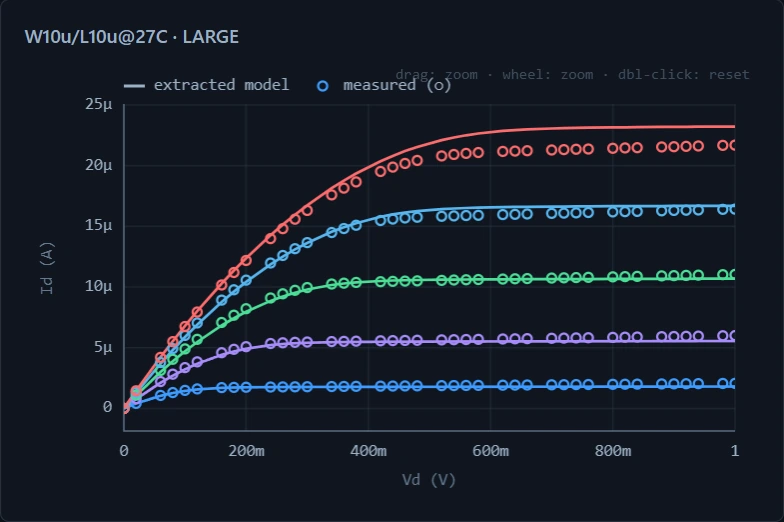
On a full production-style dataset — every geometry corner, multiple temperatures, body bias and C-V — AutoPDK went from raw wafer data to a verified, sign-off-ready BSIM4 model card in under an hour, fully autonomously. A flow that traditionally books days of an expert’s calendar. See the fit overlays →
Ready to run your first extraction?
Bring a dataset and your model of choice — we set you up and run the first extraction with you. Early access is open to a limited number of modeling teams.