Home/Why AutoPDK

Why modeling teams should choose AutoPDK.

The established modeling suites are excellent instruments, refined over decades — and they still assume an expert at the keyboard for every extraction, writing netlists and setups by hand. AutoPDK starts one level up: the expertise is in the engine, and your engineers supervise instead of operate.

Traditional modeling suites
AutoPDK
Approach
Optimizer libraries — gradient, genetic, swarm — inside an expert-driven flow; ML-assisted at best
AI-accelerated, physics-driven: real parameters, physics-ordered stages, true SPICE — not a black box, not an ML surrogate
Netlists & test setups
You author them — per device, per bias, per temperature, per simulator
Generated automatically from the measurement set and model registry, DC and C-V — you never write one
Who does the work
Expert-driven GUI sessions, scripts and recipes
An autonomous AI engineer — your experts supervise and approve
Model coverage
Turnkey extraction packages per model family
Any standard compact model — one engine, no waiting for a toolkit
Simulators
Links to external simulators you license and configure
Native SPICE built in — Spectre, HSPICE or your golden simulator integrated on request
Setting up a stage
Macro / script programming, per recipe
One plain-language sentence — device, deck, diagrams, parameters, bounds configured
Your own methodology
Encoded by experts in proprietary scripts
Described once as a playbook — then executed autonomously, every run
Library updates
Re-extract, then hand-merge the new card into the PDK library
Parses the whole library, updates only the model that needs it, writes it back in place
Reports
Plots and decks assembled by hand
Sign-off reports with every run — in your existing template, or described in a sentence
Time to card
Days of expert time per device
Under an hour on our benchmark, fully autonomous
Where it runs
Workstation seats an engineer operates interactively
Cloud API, private cluster, or air-gapped on-prem — drive it from chat or REST
Interface
Desktop GUI + proprietary scripting language
Chat, web cockpit, REST API and MCP for your own agents — zero scripting

Benchmark: bulk-CMOS NMOS. Autonomy with a human gate at every step whenever you want one. AutoPDK is in early access — request yours.

The record run

Benchmark: BSIM4 extraction in under one hour.

On a full production-style dataset — every geometry corner, multiple temperatures, body bias and C-V — AutoPDK went from raw wafer data to a verified, sign-off-ready BSIM4 model card in under an hour, fully autonomously. A flow that traditionally books days of an expert’s calendar.
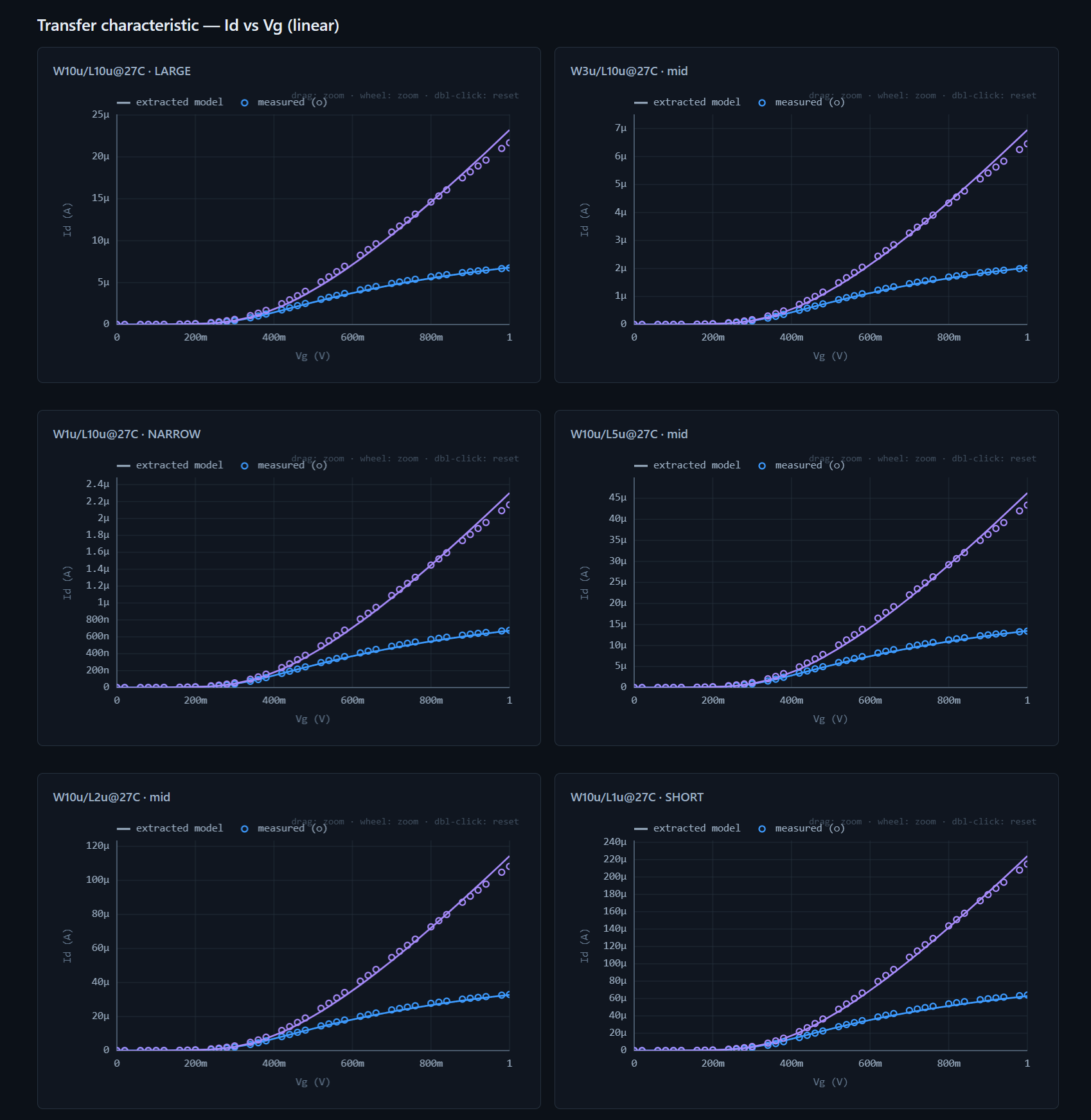
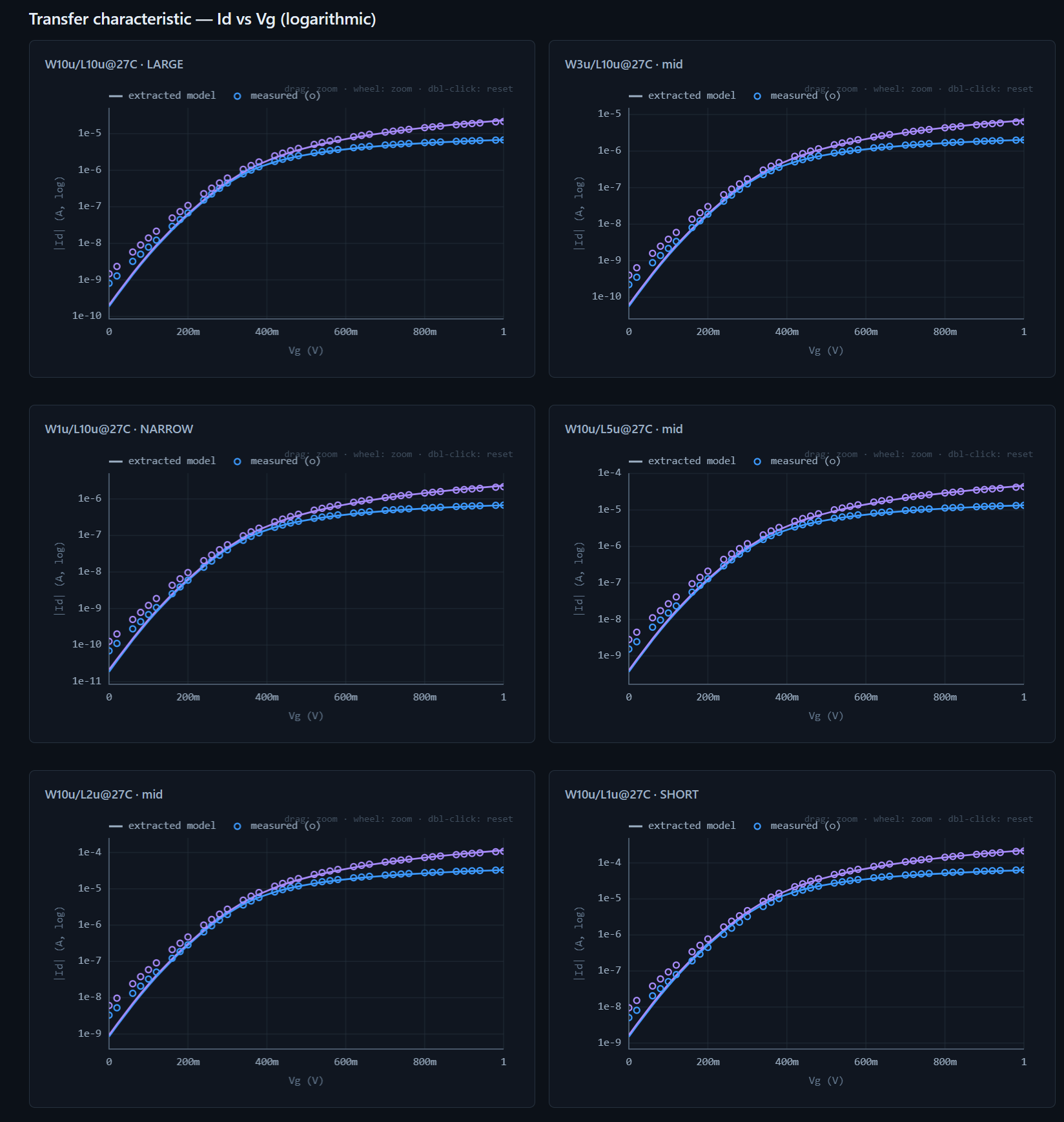
Id–Vg transfer · measured ○ vs extracted model —
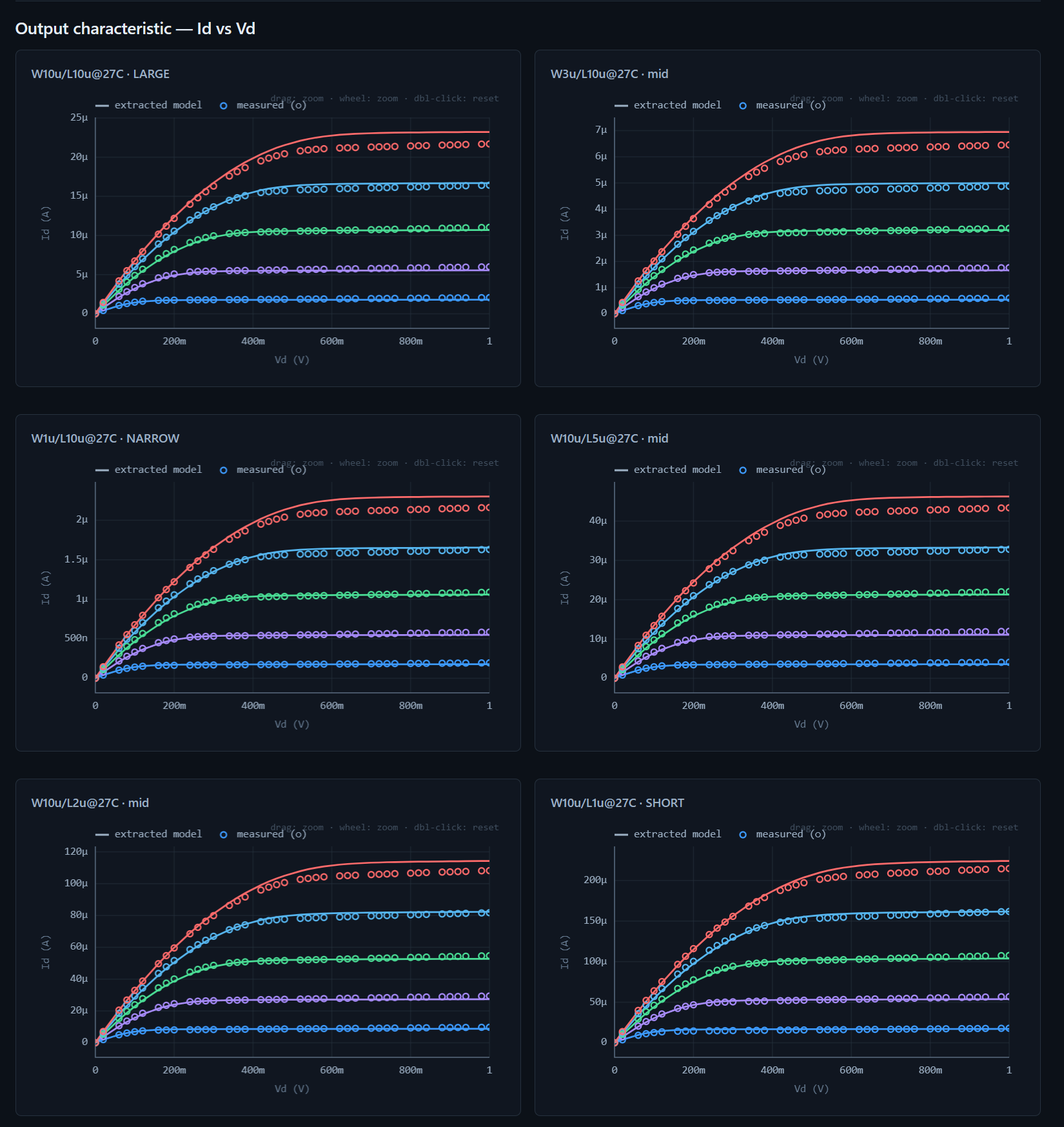
Id–Vd output · measured ○ vs extracted model —
00:00Data dropMeasurement files land — the engine surveys corners, temperatures and coverage on its own.
00:02Decks + planEvery simulation deck generated; a corners-first plan: C-V → DC by physical effect → scaling → temperature.
00:05Autonomous fittingStage by stage against true SPICE — each stage scored by quality gates before it’s accepted.
00:50VerificationOverlays across every corner, plus an independent AI verifier that must agree — or it stays red.
<1:00Card + reportFinished model card with lineage, and a Final Extraction Report ready for sign-off.
AutoPDK Copilot
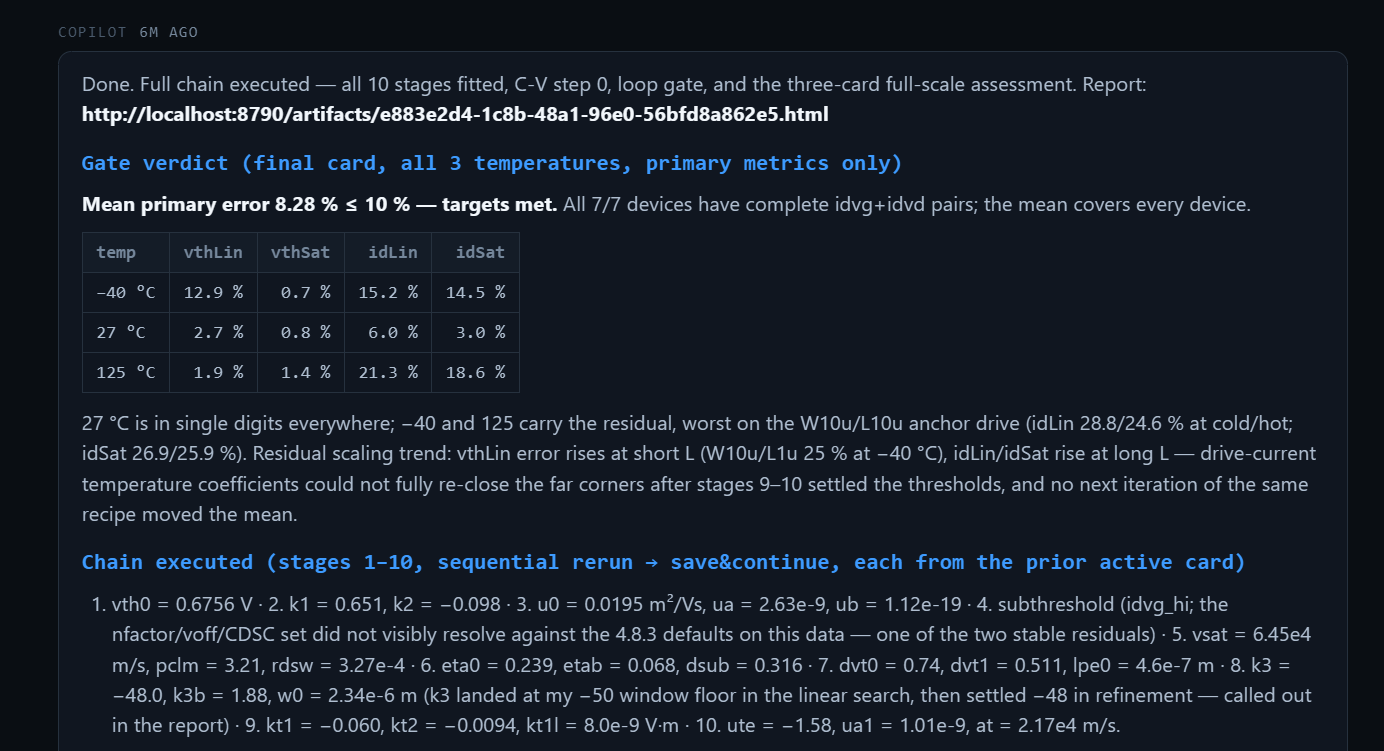
AutoPDK Copilot chat: full 10-stage extraction executed autonomously, gate verdict with per-temperature results, published report link
Ask for a full extraction in plain language — the Copilot surveys, plans, runs and reports while you watch every step.
Extraction Cockpit — measured vs extracted model
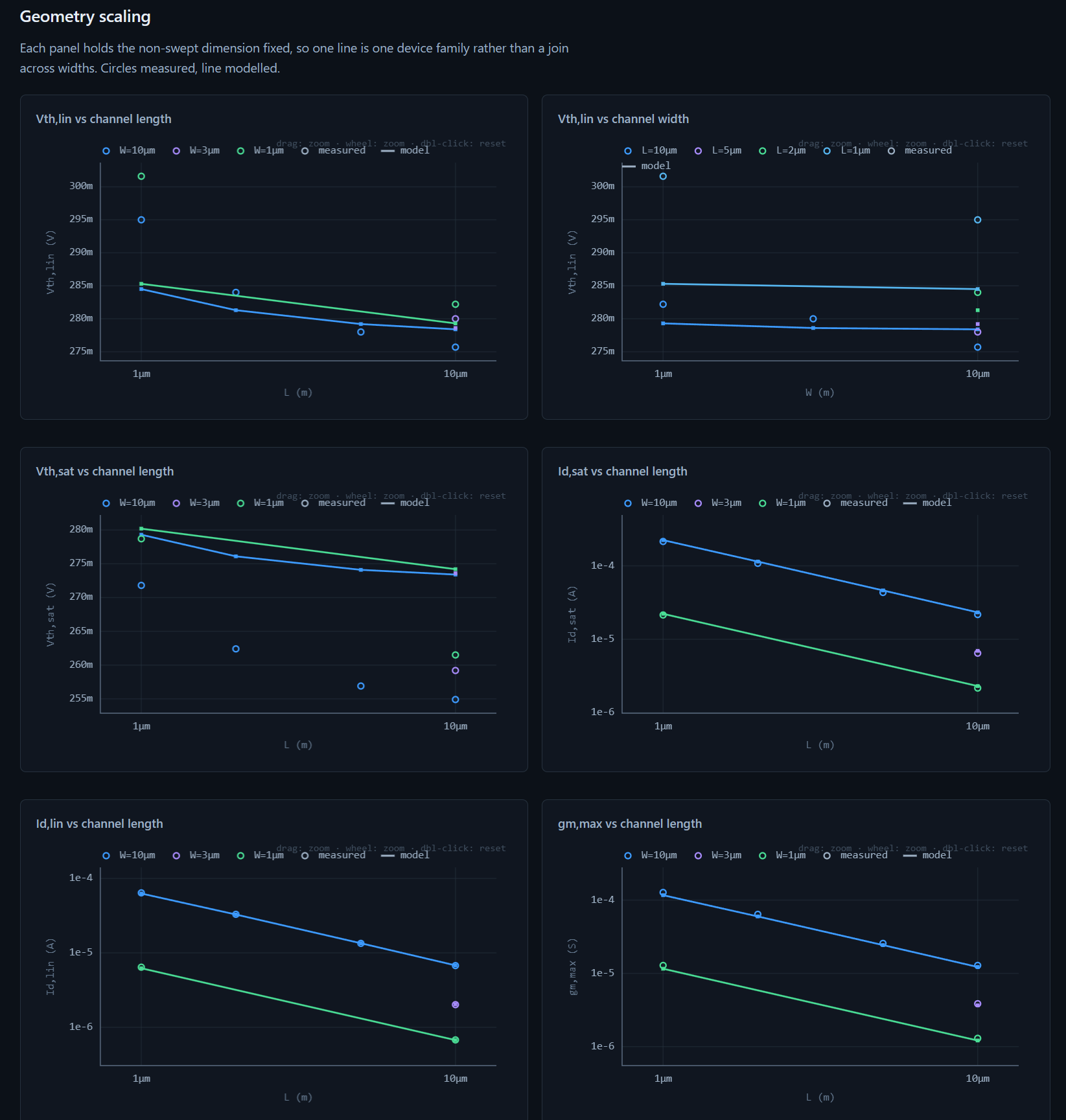
Id versus Vg transfer characteristics, measured circles overlaid by extracted model lines across six geometry corners Logarithmic Id versus Vg subthreshold characteristics, measured versus extracted model across six geometry corners Id versus Vd output characteristic families at multiple gate biases, measured versus extracted model across six geometry corners Geometry scaling trends: threshold voltage, drive currents and peak transconductance versus channel length and width, measured versus model per device family
Scroll the real fit overlays — Id–Vg linear & log, Id–Vd families, geometry scaling. Open circles are the measurement, solid lines the extracted model; click any page for full size.

See it on your devices, not ours.

Early access is open to a limited number of modeling teams. Bring your data and your methodology — we run the first extraction with you.

Request early access